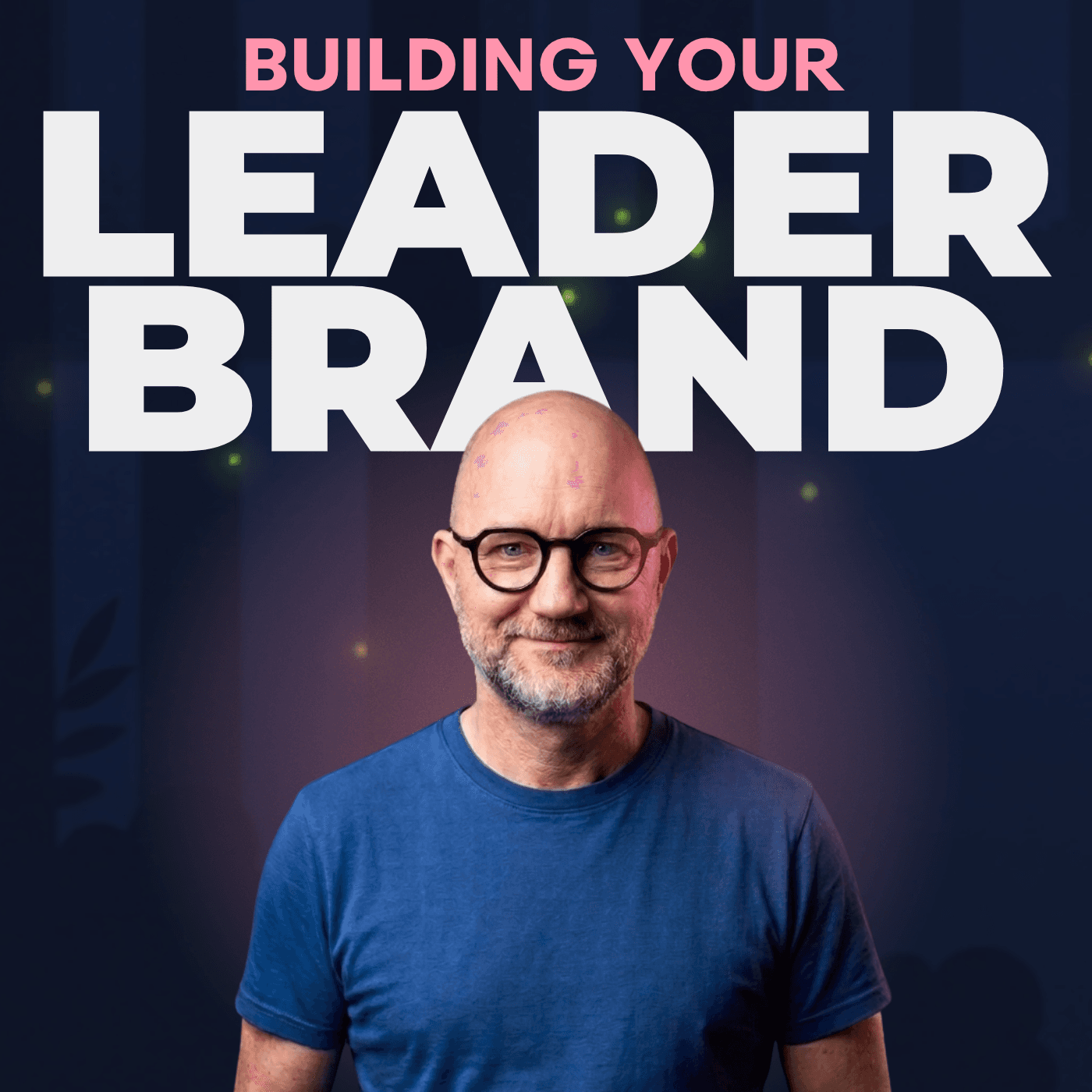
Big-Brand Secrets to Build an Unshakeable Personal Brand, with Philip VanDusen
51:42 · Episode 316
Episode 316 · 2025-10-13
Big-Brand Secrets to Build an Unshakeable Personal Brand, with Philip VanDusenBig-Brand Secrets to Build an Unshakeable Personal Brand, with Philip VanDusen
0:00 / 0:00
Today, I sat down with the brilliant Philip VanDusen, and we explored the critical importance of building your personal brand. For all of you experts, entrepreneurs, and executives out there, understanding and actively shaping your personal brand isn't just about looking good; it's genuinely about future-proofing your career and business. In a world where jobs can disappear through no fault of your own, your personal brand is your ultimate career insurance policy.
Here are three key areas we delved into:
✳️ Defining Your Brand: We discussed how to uncover what makes you tick, the problem you solve, and why you're different through strategic tools like the Brand Positioning Statement and Brand Pyramid. It's about finding clarity and making tough decisions on what you offer and to whom.
✳️ Manifesting Your Brand in the World: Once you have that crystal-clear identity, we talked about how it becomes a filter for all your actions, from product development to social media posts. This ensures everything you put out into the world is aligned and intentional.
✳️ Overcoming Emotional Hurdles: Philip and I tackled the emotional challenges of personal branding, like imposter syndrome and comparison. We highlighted the importance of being inspired by others without copying them directly, and knowing when to pull the plug on things that aren't working.
Inspired by Philip's invaluable insights, here are three actionable takeaways you can implement today:
✳️ Embrace Community, Not Competition: Shift your mindset. Instead of viewing others in your industry as rivals, see them as colleagues, collaborators, and part of a valuable community. These connections can fast-track your learning and open doors to incredible partnerships.
✳️ Content is Currency: Start creating a body of work that showcases your expertise. Whether it's videos, articles, or audio, this content acts as a digital asset that works for you even when you're not actively selling, building visibility and attracting clients over time.
✳️ Utilise the Personal Brand Wheel: Philip has developed a fantastic tool to simplify the often-overwhelming process of personal branding into 12 core activities.
You can download this resource with examples and instructions at philipvandusenn.com/pbw. It's a brilliant way to gain focus and make your personal branding efforts more manageable.
----
Get your copy of my Personal Brand Business Blueprint
It's the FREE roadmap to starting, scaling or just fixing your expert business.
Please take a second to rate this show in Apple Podcasts. ❤ It will mean a lot to me.
Mentioned in this episode:
Signature Studio
Get started today - signtaturestudio.me
Read transcript
Speaker 2 (00:03) Welcome to Building your Leader Brand. Today on the show, Bob is speaking with Philip Van Duysen. Speaker 1 (00:10) I look at personal branding as a career insurance policy. That's how I approach it. Because when you're working for a company or an agency, there can be an acquisition, a restructuring. Your job can go poof. You can have someone move in above you who wants to bring in their people to do everything, and you're made redundant by no fault of your own. It happens all the time. And I work with executives who this has happened to. A personal brand is the only thing that you carry with you from job to job. Speaker 2 (00:42) Hi there, and welcome back to Building your Leader Brand. My name is Bob Gentle, and every week, it feels like every day, I speak to incredible people who share their secrets to building, marketing, and monetizing their expertise and the mindset you need for your business to grow and thrive. If you're new to the show, then while you still have whatever device that is in your hand, take a second to subscribe. And if you're on Apple podcast, that's follow. And don't forget, you can download the Personal Brand business roadmap. Fifty pages of everything you need to start, scale, or fix your expert business. Just visit the link in the show notes, and I will read the link long form at the end of the show. So we are going to talk about the meat and potatoes today. A lot of the time we speak about things peripheral to the personal brand, to the leadership brand. But today, we're just going to dive straight into the middle with my branding, Empressario, the Mr. Philip Van Duzen, Professor Philip Van Duzen with that moustache today. Welcome. Speaker 1 (01:43) Thanks, Bob. Thanks for having me on the How does it feel? Speaker 2 (01:46) I would say you and I are friends, and we can keep things low-key today. Many of my guests, I have a lot of anxiety thinking, Oh, my God, I'm so worried about looking fancy and not making a mess of things on the show today. With you, I'm far less anxious. So we can really dive into low-key, Bob, being very relaxed, and we're going to talk about the brand. Speaker 1 (02:11) Let our hair down, if you will. Speaker 2 (02:13) Yes, let our hair down. Philip, for the listener who's meeting Mr. Philip Van Duzen for the first time, can you tell us a little bit about who you are and what it is you're actually really well known for? Speaker 1 (02:24) Sure. Philip Van Duzen, and I've had a 30-plus year career in and marketing and design, both on the agency side, the global agency side, and the global corporate side, working with big Fortune 100 clients through my career. And then about 10 years ago, I went independent and became a creative entrepreneur and consultant and built a little bit of a content marketing empire and a community of creative professionals along the way. And I've been, for the last decade, servicing small to medium-sized businesses and entrepreneurs using all those techniques of branding and design and strategy that I used with the big clients in my past and bringing it to smaller fish to help everybody else survive, too. Speaker 2 (03:15) I think also it's fair to say that you are a career mentor for many creative professionals. So a lot of people look at you as a leader in the industry and how to build that career. Is that correct? Speaker 1 (03:27) Yeah, I say that's the truth. When I was a creative leader in agencies and corporations, I had, in some cases, very large teams of creatives who I managed and grew and mentored. But then when I went off on my own, I wasn't actually intending to do that. I started doing YouTube videos and a newsletter and a podcast in order to get clients, to get visibility and build authority and to get clients for my consultancy. But then what happened along the way is people started following my content and using it to learn and advance their own careers. And when I realised that was happening, I started nurturing that audience as well. And since then, I've built courses and communities and masterminds to help creative professionals succeed in their careers, too. Speaker 2 (04:14) And every So by the time I speak to you, the YouTube subscriber count has changed a little bit. Where are we looking right now? Just so the listener rather than the user can get some context. Speaker 1 (04:23) Sure. My YouTube channel is hovering around 305,000 subscribers right now. I've been I'm posting YouTube videos for almost 10 years now. I have over 560 videos and livestreams and shorts on my channel. And I have a podcast as well. That's podcast metrics are very hard to actually nail down. But I've been doing that for about four or five years now, too. But it's definitely my secondary platform. And then I have a newsletter and do writing and stuff like that. Speaker 2 (04:58) So for the listener at home who's listening in audio only, you won't be able to see the glory that is Philip Van Duzen's moustache. And again, you also won't notice that I've grown a little beard recently. If you're on YouTube and I happen to post this on YouTube, then you can enjoy this, and you'll enjoy this story even more. So I was going to tell Philip this story beforehand, but I decided to save it. I had a beard accident recently. My beard was a bit longer than this, and I was getting really pleased with it, but I was trimming my beard, and my wife knocked on the bathroom door and wanted to speak to me. So I put the trimmer down, had that conversation, came back, picked the trimmer up, didn't realise it was on a different setting now. It took a giant gouge out of my beard, setting me back about two months. I was almost to the point where I could pull off the handlebar, and now I have to wait for that again. But you have the most immaculate handlebar there. Speaker 1 (05:55) Oh, well, thank you very much. But any person who's had a beard or a manicured moustache has had those sorts of accidents. I've had almost the exact same accident where I was trimming my moustache at a lower setting or my beard at a higher setting and went to do my moustache, and it would take out some huge chunk, and I'd be like, Oh, my God, I just start over. Speaker 2 (06:18) That's an aside for the listener. You can enjoy my embarrassment. What we wanted to speak today about was branding. What is a brand? What is an authentic brand? How do we go about understanding who we are and who we want to be for other people? And how do we go about the mechanics of that? And I thought, you, as somebody who's done this time after time after time after time for big household names. The process for the human beings is probably not too different. And I think a lot of the time we half-ass it by thinking, Well, I want to be a bit like that guy. And that's not the way to do So I think this is a conversation I maybe invite you to lead. If I were coming to you as a Kellogg's, what does that conversation actually look like? Speaker 1 (07:10) Well, with any brand, really, you have to start with your product, who you're delivering it to, and why it's better and why it's different. And when you have an established brand like a Kellogg's or something like that, they have products and customers already, but they're always adding to or They're reducing the number of products they have. They're always trying to add additional consumer audiences or consumers. And so that's always an ongoing process. But when I started my own agency, the mission I had was to take all of these brand strategy and business building processes that we had used with the P&Gs and the PepsiCo's of the world and simplify them to the extent that they could be used in a really advantageous way for even a solopreneur or an entrepreneur. But definitely small to medium-sized businesses that don't have the money to spend $250,000 to hire a land or associates. And So I took a number of the key strategic tools that I used in those big agency situations, and I simplified them to a way that I could lead an individual or a small company through a series of tools to discover who they were and how they could position themselves in the market to become clearer to themselves and also clearer to their consumers. Speaker 1 (08:45) And when you get that clarity and establish that definition, that's what really sets you on the path to success. Because a lot of brands and people, sometimes they start with a product and they just throw it into the market And they're not very... They don't do it in a very considered way or they haven't preconceived what it is. And so that's part of the process. You have to do... The first part is really you have to do an internal discovery of what makes you tick and why you are passionate about what you do and how that passion goes into your product and the problem that it solves for somebody else. Speaker 2 (09:29) So So that discovery process can happen organically and naturally for a human being over time if you're quite an introspective person, let's say, if this is a personal brand. If you are not naturally introspective, as many corporations are not naturally introspective organisms. In corporations, you probably have structured processes that you work through to facilitate that introspection. What does that look like? Because I suspect that's applicable to the individual and the solopreneur as well. Speaker 1 (10:09) Sure. I mean, one of the tools, the simplest tool, the two simplest tools that I use are the brand positioning statement and the brand pyramid. And the brand pyramid is literally a pyramid, and it's basically structured after Abraham Maslow's hierarchy of needs, pyramid. But as the branding industry is want to do, they have a tendency to take constructs like that and turn them into branding tools because they can be very powerful to helping define and dig into what a brand is, what it does, how it's better, how it's different. And in that brand pyramid, you start off at the bottom with, what are the functional attributes of the product? You move up to the next level, and it's, what are the emotional attributes of the product? And then who does it serve? And as you move up the pyramid, as you get to the top, you come to this one singular idea, this brand essence. And that's usually communicated in one or two words. And that is the thing where it's the rarefied air where you are establishing an indelible mark and a way to be remembered in your consumers. And that's your goal, is to try to live to that two-word mission standard. Speaker 1 (11:31) And so that tool is really handy because when you have to populate it, it basically comes blank. And as you have to start putting the words into it, you have to think very deeply about what these key aspects of your brand are. And because there's not a lot of space in these tools, you also have to really, really wordsmith and hone down and refine how it is you are defining it and what the exact words are that you're using to do it. The brand positioning statement is much the same thing. It has five different parts to it. I'm not going to get into the specifics, but essentially it talks about who you are, what you offer, who you offer it to, why you're better, and why you're different. Those are the the key aspects that any brand has to figure it out. I did this tool with Gap Inc once, and of course, they have 15 people in the meeting, and everyone's wanting to get their thumbprint on it. And so the sentence ended ends up being 250 words long, but you have to get it down to 50. And so it's this question of refining and tightening. Speaker 1 (12:41) And the really interesting thing, when you do this with a big corporation, and this is an interesting point, Bob. You do this with a big corporation. And one of the things that I'm always completely fascinated by is that when you're building this very simple sentence that's capturing these very simple core tenets of the brand, you will get C-suite people who don't agree with each other, or they have very different takes on what actually this thing should be or how it should be phrased. And that exposes this disparity between how a brand even understands itself. And so going through the process of building these tools alone illuminates Discord within the company. And when you're doing that with an individual, it's It's much the same thing. And the fact that you have to articulate what you're offering, why you're better, why you're different, who you're offering it to in a very, very succinct way. And when you're doing that, it's forcing you to make decisions about what you do and how are you going to do it? Because as we go about our businesses, we're like, everyone wants to be everything to everybody, and you can't. And so going through the practise of populating and writing, creating these brand strategy tools, it forces you to decide. Speaker 1 (14:03) And by sharpening that pencil, that's what makes you more effective in what it is that you do. Speaker 2 (14:10) Listening to that, you can completely understand why an organisation would need somebody to come and facilitate that process. Because it's just by its very nature going to surface disagreement. And in a large organisation like that, You're going to have strong characters with strong opinions and fixed ideas that don't agree. On the individual level, I have a similar exercise that I work through with clients to help identify what I would call a value positioning statement, which is even simpler than the five. And it's really emotional for them to do it because I can't do it for them. And the analogy I often end up using is it's a little bit like polishing a diamond. If you want a diamond to shine really, really brightly, you have to get rid of extremely valuable material. You're making this diamond smaller. There's diamond lying on the floor, and you have to be okay with that. Because if you want this thing that's going to really shine for the people who matter the most to you, you're going to have to leave the others. But it's that beacon that you're actually going for. It's a beacon that will get you out of bed, and it's a beacon that will motivate other people. Speaker 2 (15:28) But it's a very challenging thing to do, and most people will avoid it. And I guess that's why a lot of personal brands don't necessarily appear very clear. And a lot of corporate brands don't seem very clear. Speaker 1 (15:42) Yeah, and it's also why you and I have jobs, right? Because it's very, very difficult for an individual to see themselves with that clarity, because when you're talking to yourself, you talk in circles. And you have to have a mirror, and hopefully a mirror who has had some experience in business and in the world and could also reflect you back to you so you can see yourself more clearly and help facilitate that decision making because it's very difficult to make those decisions by yourself. Here's a perfect example. I lean creative professionals. And just like the cobbler's children have no shoes, trying to get a creative professional to design their own website is telling them to cut off one of their hands. It's really, really difficult to do. They can design beautiful, functional, exceptional websites for their clients. But when it comes to doing it for themselves, they freeze, they lock up. They don't have the insight. They don't have the ability to look at themselves at a distance. And that's what mastermind communities or professional coaches do for our clients. Speaker 2 (16:54) So understanding what your brand is is fundamental. We've covered that a little bit. There's probably a whole conversation around the discovery phase. But in order for that brand to exist in the minds of other people, there has to be vectors, lines of communications, signals being transmitted. How do you design that process for going from, Okay, we now have established this identity. We understand who it is that's showing up in the Now we need this to exist in the minds of other people. There's a million ways you could do that. How do you make those decisions? And then we can correlate this to the individual afterwards. Speaker 1 (17:43) How do you make it? I'm not sure I totally understand the question, but how do you take that brand idea and how do you manifest it out in the world? Speaker 2 (17:52) Exactly. Right. Speaker 1 (17:54) And that's part of that process. It's, for instance, when you design or develop these strategic tools, which is basically codification or documentation of what your brand is, but in a very succinct way. What you're doing when you create those things is you're basically creating a roadmap and a philtre from which you put everything through. And I tell my clients this, I'm like, if you develop a product idea and you have some brilliant ideas, some get-rich-quick scheme that you want to develop, you have to put it through this philtre of what your brand is, your brand strategy is. Because if it doesn't fit through that philtre, you shouldn't do it. And that can be frustrating, especially sometimes to startups or entrepreneurs who get some crazy great idea, but it falls completely outside of their core mission or ethos, and they want to pursue it. And you're like, no, don't, because not only will it be distracting to your core mission, but it also may degrade your core brand because it's going to be confusing people as to what you are about or what you offer. And so as soon as you develop that core manifestation of your brand within your brand strategy and your brand plan, that is what actually dictates what you will develop. Speaker 1 (19:22) It dictates the products, it dictates the services, it dictates the experience you're going to strive to give your customers. And that ends up manifesting itself in design, in customer interaction, in email communication, in social media posts, in the development of media. It essentially dictates everything that you do. And if you use that philtre correctly, then what you put out into the world is going to have the desired effect that you're wanting. Speaker 2 (19:54) So it's a bit of a pivot, but I'm interested in your take on this. People approach They're a personal brand in many different ways, and some people will approach it from the perspective of, I have good self-knowledge and self-awareness, and I have a degree of confidence, and I know how to express myself. And it appears quite organic and natural, where there's another approach thinking, Well, I need to be a little bit like that guy. I'm trying to think what the question is here. In a corporate brand, you have this process of Uncovering it, discovering it. We have covered this, but I guess the question I want to come to is more of the emotional objections to that. What I mean is, Comparison, imposter syndrome. Corporations don't suffer from comparison and imposter syndrome in the same way. They don't react emotionally in the same way. They don't have scarcity mindset sets in the same way. They don't panic and make knee-jerk responses in the same way as a lot of us do. So when you're working with an individual in a personal brand perspective, what tools can you give them to keep them on the straight and narrow so that they don't second-guess themselves. Speaker 2 (21:17) They don't fall into fear quite so often, and they don't deviate or get distracted. Am I making any sense? Speaker 1 (21:27) Yeah, you are. I mean, having worked with the A whole lot of corporations, I know that corporations do freak out. They do compare themselves. They do get imposter syndrome. They are constantly creating tornadoes of anxiety for themselves, comparing themselves to their competitors, especially when their competitors are eating their lunch, either competitors who are at their same level of success or competitors who are newly entering the market, who are hungry, who are nipping at their heels. I was just talking to a client yesterday, actually, who had that exact problem. They had some upstarts. They were one of the biggest manufacturers of their particular product in the world. And there are a number of upstart companies that are doing social media much better than they are. And they are getting a lot more brand recognition and customer awareness than they are. And so they're having to look at... Because big companies, big brands of any kind can get fat and happy, right? And they don't pay attention to what they're doing. And then someone comes along and starts eating their lunch, and they're like, Oh, what is going on here? What are they doing better and different things than we are? Speaker 1 (22:41) And they have to reevaluate how they're approaching things and sometimes make huge pivots in how they're doing things. And to circle back to your question with individuals, what I would say is I try to counsel people to be inspired by others, but not to copy others. Because there are things that you can be motivated by in looking at what other people or individuals or companies are doing, and find and extract the energy from what it is that they're doing. And apply it to how and what it is that you do. And this runs in contrast to that great quote by Picasso, who said, Mediocre artist's copy, but great artist's steal. There is There is value in looking at who it is that you want to be when you grow up, like to look at another brand or another individual and say, That's what I want to be when I grow up or get successful. And to look at what they're doing and how they're doing it and where they're doing it. And to start to model some of what you do after that, to use that as a bit of a roadmap, but not to copy it directly, A. Speaker 1 (24:00) And the tough part for most, as you know, because you just mentioned it, which is get demoralised by comparing yourself to them. And even the biggest brands will compare themselves to some other brand that's more successful than them and get demoralised and get stuck. And I see it happen to entrepreneurs and solopreneurs all the time. I do it. I see people who are in my space and doing things better and differently than I am. And I'm like, damn, they're killing it. I wish I could do that or I wish I was that successful. Here's a perfect example, right? Yes, I've built a really great content presence on YouTube. It has built my business. It's brought me 90% of my clients through the last decade of my business. But I was trying to also build an audience on Instagram. I tried everything on Instagram for seven years. I beat that horse. And for some reason, I don't know what it was, I could I did not break through on Instagram. And I probably kept doing for two or three years longer than I should have because I should have just realised I am not winning on Instagram and just stopped doing it. Speaker 1 (25:11) And a couple of years ago, that's what I did. I just said, Hey, I'm pulling the plug on Instagram. I'm going to put my energy into my podcast and my mastermind community and YouTube. I'm not going to spread myself too thin. Same thing happened with me on Twitter. That's a whole another story, but in terms of the death of Twitter. But trying to be everywhere and trying to win everywhere. When I was seeing some of my competitors totally killing it in Instagram, I was like, What are they doing that I'm not doing? And I would model after what they were doing, and I still wouldn't break through. And after a while, I was just like, You know what? Instagram is not for me. And just be okay with that. But pulling the plug on things that you've put a lot of heart and soul and energy and time and money into is hard. Speaker 2 (25:57) Yeah. It's the old fallacy of loss. It The more you've invested in something, even if it's not working, maybe tomorrow. One area I'd like to talk about, and it was as you were speaking, I realised, Philip's the guy. You've worked with lots of large corporations, and I know you do work in personal branding in large corporations as well, consulting. What does that conversation look like a lot of the time? Because I think there's a complacency, maybe not in the right word, but a lot When you have leaders in large organisations resist the idea of personal branding because in many respects, they feel like they don't have to. It's an area of discomfort that there's no pressure for them to move into. There's no bad consequences. In a corporate role for not investing in personal brand. I'm happy to be told I'm wrong because I don't believe that. But I'm interested to know what that conversation looks like when you're actually having it. Speaker 1 (27:01) I look at personal branding as a career insurance policy. That's how I approach it. Because when you're working for a company or an agency, there can be an acquisition, a restructuring your job can go poof. You can have someone move in above you who wants to bring in their people to do everything, and you're made redundant by no fault of your own. Happens all the time. And I work with executives who this has happened to. A personal brand is the only thing that that you carry with you from job to job that has no effect on where it is. Your personal brand is not affected by where it is that you're working. And the authority and the visibility that you build as an individual in building a personal brand is the one thing that is going to carry you over from job to job. And it's also going to... And the network, because personal branding, also part of personal branding, is building a network. And a meaningful network rather than just like LinkedIn numbers, a meaningful network of people, those are also the things that are going to get you into your next job or get your resume on the desk of the next hiring manager. Speaker 1 (28:11) And the visibility of your personal brand is what's going to do that, too. And you were totally right. I was looking off in this space when you were saying this because I was thinking about it, which was you were saying how there was no downside to not building a personal brand when you're working for a company. And that's very true because companies, they've been very slow in coming around to seeing the value of having people have a visible, recognisable presence as an executive in their company because they just see it as a liability. Big companies see everything in terms of liability. And so they just see it as, Oh, what if so-and-so says something stupid on threads or Twitter, and this comes back to bite us? So they don't want anyone to have any visibility, and there is no downside for them. But the false sense of security that corporations instil in their employees by sending them that paycheck every month and giving them those wonderful benefits and the stock options and the bonuses and that thing. They keep you in golden handcuffs. But what they don't want you to realise is that they can snatch that away all at once overnight. Speaker 2 (29:30) Yeah. Speaker 1 (29:30) And it's even more important right now, Bob, because what I'm seeing in corporate behaviour is that it's doing nothing but getting worse than getting better in terms of how they're treating their employees. I had a friend of mine, a very close friend of mine, who had worked for 20 plus years with one of the largest creative software manufacturers in the world. And there was a restructuring. Some people came above, wanted to bring in their own people. And he was made redundant after like 20 years. And the amount of time they gave him as severance for 20 years of service was three months, which is insane. And we are talking about a multi, multi-billion dollar Corporation. And that behaviour, for me, is just it's criminal. And so the only thing that we can do, you and I, as people who to coach people in their personal brands is give them that career insurance policy, help them build that suit of armour, which is going to be the thing that protects them when that thing happens. And the creative professionals that I work with, I worked with mid to late career creative professionals. And if anyone's watching the video of us, you can tell I'm late career creative professional because of my grey. Speaker 1 (30:52) But that population of employee or that population of career Career professional is very, very subject to ageism. Ageism is rife in the creative industries. It's second only to the tech industry in terms of ageism. And what happens is people get up to 45 or 50 They get made redundant or something happens, they move, their spouse moves, they have to get another job, and they're suddenly like, oh, shit, I'm not getting any interviews. None. Nothing is happening. And they're surprised by it. And my My goal in life is to help anyone who's a creative professional not be surprised when that happens. Speaker 2 (31:37) I think you're absolutely correct. From the career insurance perspective, it's your responsibility. And when people tell me running your own business must be so risky or I couldn't do that, it's so risky. You know how many people have to get pissed off with me before I'm out of a job? It's a lot. Whereas if I have a job, one person, one person who probably has no idea who who I even am has to get annoyed or actually just not even like the look of a spreadsheet number. She makes a call and says, You need to lose three people. I never want to be in that situation. But I think there is a flip side to this for the corporations. I think if you look at the way the world is going, yes, a lot of companies are being more callous with their people than they've ever been before. But I think there is another organisation where they do realise where everything is being commoditized, where everything is being virtualized, and we want to be able to attract and retain good people, then we're going to have to build an organisation that they really want to be part of, and especially when those teams are distributed and they will never meet the leadership team. Speaker 2 (32:53) If they want employees that are invested in the organisation, invested in the journey, invested in this brand story, then it needs visible leadership. And leadership is largely invisible and transactional. But if an organisation has visible, motivated, motivating leadership, I'm not going to move for an extra $50 because I'm invested in this story. I'm invested in this journey. And similarly, if I'm attracting investment, I'm going to invest in a company where I'm investing in the people. And if all industries are commoditized and I'm simply another number, I'm going to go to the company for whom I feel that number matters, and it's going to be where I'm invested in the people. I think you're absolutely right For a lot of organisations, a lot of organisations, there is no upside. There is only a liability for the personal brand. But for those organisations that are willing to be a bit more courageous, the upside is tremendous. And that's what I'm really encouraged by. Speaker 1 (34:00) Yeah, I agree. I did not make it seem like every big corporation is evil because they certainly aren't. And there are a lot of corporations which are understanding the importance of that and retention And also company culture. I think company culture, in its truest sense, has come into its day, come into a much higher level of importance than it ever was before. One of the challenges Challenges to that, though, Bob, and you mentioned it, which is the virtual workplace. And one of the things, one of the little factoids I'll drop is that 80 % of your chances of being promoted if you work for a company or an agency is your visibility to upper management. A lot of people think that you're getting promoted because of the great job you're doing. It's not because of the great job you're doing, it's who sees you doing a great job what you're doing. And that aspect of promotability and career advancement being based in upper management, having visibility to what it is that you do or you doing that thing, The virtual work environment has just crushed that. And so that's one of the biggest challenges for people who work in virtual environments is how do I get visible to management doing the job that I do? Speaker 1 (35:30) And so I'm constantly counselling people to say yes, say yes to every opportunity that comes your way, even if it's above and beyond your job title or your salary level. If it gives you any visibility to the people who are in management, whether it's throwing together a deck for a CMO or something like that on the weekend, it's like, do it. Because in a virtual environment, that activity is what is going to help you get over that location divide. Speaker 2 (36:02) I remember watching something on TV. I can't remember what it was. She came to work in an organisation, and she felt like she was being kept down as a woman. And another senior female leader took her under her wing and she said, This woman gave me the best advice I've ever had. And it's what's driven my entire career. And it boils down to one thing. Every day, walk the floor. We automatically think of personal brand as online and video and things like this. But actually, our personal brand, pure and simple, is how we exist in the mind of other people. It's the end of story. And how we shape that. In a physical environment, you can walk the floor. But in a virtual environment, you can walk the floor. What you rightly identified is you need to find alternative routes into the minds of the people for whom you need to matter. And yeah, it is going to be saying yes to opportunities because opportunities are vectors to awareness. But with a bit of creativity, it can be a lot more than that. It could be connecting on LinkedIn with your leadership team. So when you post a selfie at the weekend of you just doing a little bit of extra work, they actually see it. Speaker 2 (37:25) Something I tell people all the time, and you'll recognise that somebody asks you to do something for them. As a client, you say, Yeah, I'll do that for you. But you do a little bit of extra. They don't know you've done that little bit of extra. So you need to tell them, You asked for this, but I've done this, too. It's a gift. It's okay. I'm not going to charge you for it. But if you don't tell people you've done that, it's taken for granted. It's all these little opportunities to bring a little bit of surprise and delight that we never really think about. And ultimately, how these people feel about us directs our opportunities. So I love that. It's a wonderful observation. Speaker 1 (38:05) I love the walking the floor thing. That was brilliant. And another thing that I found out recently, I was polling my community, the one that I run, and I was asking How many people do they go to conferences or how many conferences do they go to a year? And I was shocked at how many people actually don't go to conferences. And I've always been... I go to a couple a year, right? But the thing about And we've met at a conference out in San Diego a number of different times. And the one thing I know about conferences, it's conference is a two, three-day commitment, right? And you're walking the floor, basically. And what happens to me when I'm at conferences, A, I come out of them with a moleskin that's half full of notes and ideas and tools and techniques that I'm going to try. And then the other is I come out with photographs of people's badges with their QR code on it and 50 different websites and people that I'm going to connect with on LinkedIn. And the amount of networking fuel that I... And this is not just networking, networking is a stupid word. Speaker 1 (39:13) It's like partnership opportunities. That I come out of a three-day conference with can last me six months of to-do list items in networking or people to connect with or people having a meaningful follow-up email message to, which actually is not going to get thrown in the trash because you're talking about the time that you talk to them at the conference. And so I think that that aspect of battling against the virtual environment aspect of work these days is, how can I show up in the flesh? Where can I show up in the flesh? And how can I make that valuable? Speaker 2 (39:53) Something I've been paying a lot of attention recently to is how opportunity comes into a business. And statistics seem to suggest that in a healthy consulting business, and I would say, yours is a consulting business, mine is a consulting business, most businesses that don't sell physical products are, in one way or another, consulting businesses. But in a healthy consulting business, 60% of opportunity comes in through our relationships, through our network. And I'm sure that's reflected in you as much as it is in me. 20% to 25% through our content and content marketing, something like 10, 15% through outbound sales activity and a tiny little sliver of ads is normal. This is why our network and what the wider network thinks of us, again, our personal brand, is profoundly important because it amplifies our referability. But if you're in a as an executive or any job, the majority of great jobs are never advertised. They go to people who know people. They exist in these informal networks, and they will go to the people with a magnetic personal brand first. The people who the perception is, this is somebody who will bring value into our organisation. Speaker 2 (41:24) You can leave this to chance and just be a CV or a resume on a list. Or you can invest in your personal brand so that when the time comes, you're the guy. I think that's another way. I've never really looked at it until this conversation. So useful. I think we should probably pivot now into my three things or more importantly, your three things. Every week, I invite the guests to share three things people can take action on today. Books, podcast, mental models, favourite apps, it doesn't matter. Three things you can go and do and be better today. So, Philipp, thing number one. Speaker 1 (42:07) Well, when I was reading your to-do list for the podcast, I read it as Tools, tactics, and Models. And for me, The things that I wanted to talk about, two of them are models, and one of them is an actual tool. The one model or idea tactic that I've been most concerned with over the last few years is embracing community and not competition. A lot of people see people who do what they do as competition. And I think it's more important for people to think of their colleagues in industry as colleagues, as partnership opportunities, as a community of like-minded people rather than competition. And because of the challenging economy and how challenging it's gotten as the world has become more virtual for all these reasons we've been talking about, the need to build and find a community that you can engage with regularly is more important than ever. And it's why I built my mastermind community called Bonfire, it's built on that principle of career insurance. It's that your career insurance is your visibility as a personal brand, but also on your meaningful network of colleagues, because that is where you are going to learn things faster, get access to tools and techniques quicker that you might not have come across in the past, and also build relationships with people that are going to turn into something. Speaker 1 (43:48) And so the idea of embracing community instead of looking at it as competition is a mindset shift that is the gift that I'm going to give your listeners, is to just think about how it is that you approach your thought processes around people who do what you do and see if you can start to think about that in a slightly different way. The next one is, and when you are giving your statistics about where business comes from, for me personally, when I started my YouTube channel, I was getting 80 % of my new clients directly from YouTube within a year. And that has stayed pretty constant over the 10 years that I've been independent. And so the other mindset or tactic is content is currency. You're not You're not just putting... You're not just going, Oh, look at me on Instagram. You're not an Instagram model, right? What you're doing is you are creating a body of work. I think about it in terms of an artist, an artist who's creating paintings and drawings and prints and whatever. Over time, they create a body of work that tells the story of their artistic career. The same thing happens for people with personal brands who are cataloguing and capturing They are ensuring their expertise in video, audio, writing, whatever that is, photography. Speaker 1 (45:21) And they are creating a body of work. And that body of work over time is something that can work for you even when you're asleep. And it's building this idea that that content is actual currency in your business. And just like people were coming to me from YouTube to hire me as a consultant and designer, that content that I've done on YouTube literally pays me while I'm asleep through sponsorships or advertising. And through people who I wake up and there's three emails from people saying, Hey, I saw your video on so and so, and I'm really curious about your community. I'm really curious about one on one coaching with you. And that stuff is out there and working for me for free. This is not paid push advertising. This is sweat equity content, body of work stuff that I put out into the world and it's going to be there. I have videos that are eight years old that are sending me clients right now. I mean, it's ridiculous. And to look at content as currency and to just start. And that's the biggest hurdle that people have about doing any content is starting. They think that people are going to look at them and say, What an idiot. Speaker 1 (46:39) And it just doesn't happen. It just doesn't happen. Okay, so the third one, the final one that I'm going to give. And this actually is a tool, and it's also... I'll be honest, it's a lead magnet, yes, but it's an incredible magnet, and it's super, super handy. And you, I know, have a lot of tactical tools that you share with your community. This tool that I developed is called the Personal Brand Wheel, and it's basically a tool that simplifies the idea of personal branding and breaks it down in 12 core activities. It helps you figure out who you are as a personal brand, and then how you come out into the world, how you engage with people, how do you track your progress within that. Because when you think about personal branding as your I'm sure your listeners are feeling right now is it can be very overwhelming. There's a lot of moving parts in this. So how do you simplify it and how do you bring it into a focus that makes it easier to attack? And so that's what this tool is. It's called the Personal brand wheel. And if you go to my website, philipvandouceyn. Speaker 1 (47:48) Com, and I'm sure the link will be in the show notes, /pbw for personal brand wheel. You can download it. And it comes with examples and instructions, and I think that you'll get a lot value out of it. Speaker 2 (48:01) I will go and have a look at that shortly. I'm quite excited. I love new tools. Philip, this has been extremely valuable for me. I've really enjoyed it. So many new ways of looking at things, and I absolutely agree with what you were saying about competitors or peers. It's quite understandable, and I do remember a time in my business where if you'd thrown me in a room with another agency owner, thrown in a knife and turned off the lights, the results would have been predictable. I now find myself in a place where I really don't think about competition very often. And what I discovered as a byproduct of this is that the people who are most likely to be in my direct competition are probably the people I have the most in common with in the world. And for me, many of my competitors have become some of my best friends. Purely because of this, we are on the same page, both practically from a business perspective, even metaphysically. It's really interesting for me. It's difficult. I think this is, again, why the personal brand is so important because it's your route to escape scarcity. Speaker 2 (49:19) If you can bet on yourself to the extent where you become visible to enough people, there's enough people out there who will go, Yeah, you're a good guy. I like your vibe. And they will not be in your neighbourhood. They'll be on the other side of the world. And you suddenly find yourself liberated from this local competitive mindset. And it's the best place to be. And I would wish that on everybody. So if you take away nothing today, take away that. Co-opetition is the way forward. Speaker 1 (49:50) Absolutely. Speaker 2 (49:52) Philip, it's been a lot of fun for you at home. I hope you have enjoyed this, as well as the personal brand Wheel, which is going to be awesome. You can also download the personal brand business roadmap. You will find it in the link somewhere around this podcast. Before we do go, take a moment to leave a review. That's a five-star review. Like the fingers on your hand, don't forget them. Count them if you're unsure, especially if you're listening on Spotify, because I'm not ranking as well on Spotify. As I do on Apple podcasts, I'm unassailable on Apple podcasts. Spotify needs to wake up or change the algorithm, but a review would be really nice. Thanks again at home for listening. Philip, you have been awesome. Speaker 1 (50:34) Thanks, Bob. Thanks for having me on the show. Speaker 2 (50:36) It's my pleasure.